

A tiny urban-wilderness project at the corner of Fifth Avenue and Polk Street by Elly Scott
Monday, December 25, 2017
Sunday, May 7, 2017
Picnic Table
This winter I cleared one corner of the Butterfly Meadow of invasive bush honeysuckle, euonymus, English Ivy, and privet. Underneath the vines and brush I found the remains of raised beds and pathways lined in black plastic. This corner is always shady in the summer, underneath the arching branches of a mulberry tree.

I bought this slightly damaged concrete picnic table with benches at Architectural Antics, a wonderful salvage shop on North Broadway. Now there is a civilized place to sit, just like a real park. Imagine yourself drinking coffee in the mornings, writing in your journal, thinking things over.


I bought this slightly damaged concrete picnic table with benches at Architectural Antics, a wonderful salvage shop on North Broadway. Now there is a civilized place to sit, just like a real park. Imagine yourself drinking coffee in the mornings, writing in your journal, thinking things over.


Sunday, April 3, 2016
Violet Pickles


Too edible to mow, I picked a bowlful of these wild violets growing in the Butterfly Meadow, and made pickled violets, a thing I made up. If violets are good in salads, and so is vinegar, little vinegary violets should be no problem.
I used a recipe for pickled onions and added some other yard herbs, including some volunteer spring onions I found. In some batches I used white vinegar and in some I used apple cider.


Monday, January 25, 2016


Sunday, January 3, 2016
The Holly and the Ivy

70 degree temperatures led to bare feet in the meadow on Christmas Eve. On the western edge of the clearing grow two American holly trees, native evergreens festooned with bright red berries this time of year. The leaves are prickly and the berries are poisonous to humans, but the smooth bark of the trunk and branches make this tree perfectly climbable, with a little boost.
Holly berries are a favorite wintertime feast for birds, and we've spotted many different species perched in the branches of these two trees. What species are these?

English ivy grows profusely on this side of the meadow in the shade of the trees. English ivy is an invasive species from Europe. Left unchecked, it can eventually smother a tree under thick woody vines and a blanket of dark green leaves. In the woods and meadows of the American South, English ivy chokes out vast areas preventing other plants from growing and creating an "ivy desert." Like its invasive cohort, privet, English ivy easily escapes gardens and should not be planted or cultivated in places where it is invasive.
A few years ago, a friend and neighbor took it on herself to save the life of a Magnolia tree growing in the yard of her rented apartment, and sawed through an English ivy vine as big around as a tree sapling. The tree in the far corner in the photo below, a hackberry I think, needs similar rescuing.

Thursday, December 10, 2015
2015: The Year in Blooms
From February's purple crocuses to the rudbeckia still blooming in December, the meadow is nearly always in bloom.


Thursday, March 12, 2015
Spring!
Spring is coming to the Parkridge Butterfly Meadow!
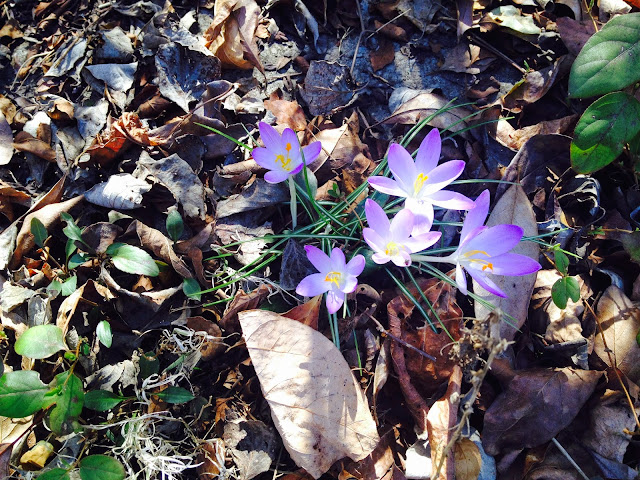


If you look closely at this picture, you can see an early honey bee buzzing around the crocus.

Tuesday, January 20, 2015
A Righteous Pile of Mulch


Thursday, July 24, 2014
Hope in the Meadow
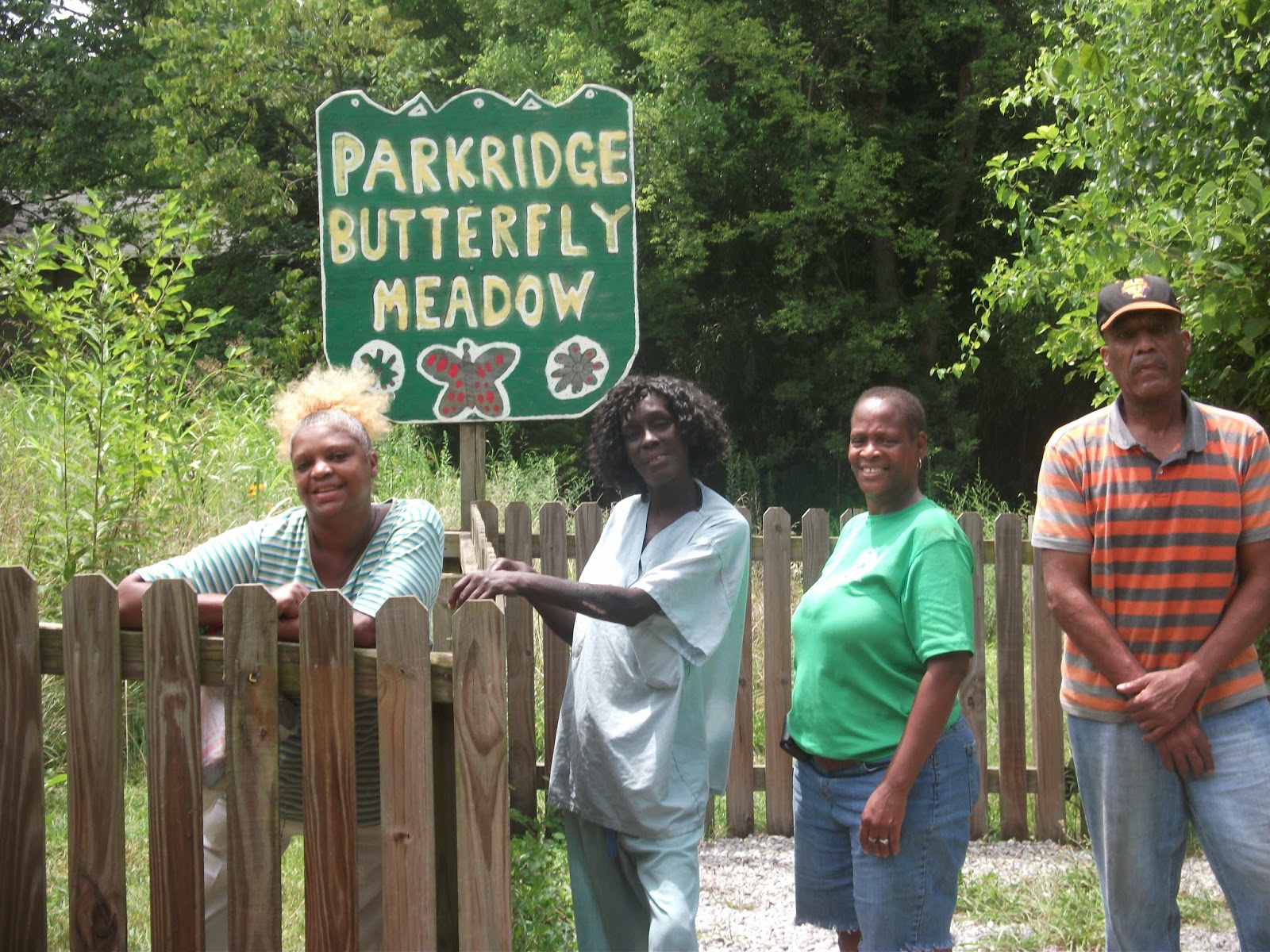
Today the Parkridge Butterfly Meadow got some much-needed help from a neighborhood service group.
Members of the church New Hope Family of God, in partnership with Hope Central, a Christian community center located on Woodbine Avenue, created an outreach program to perform community service and neighborhood improvement projects in Parkridge. The team of five worked in the Meadow for two hours clearing invasive weeds, mowing paths, and prepping flowerbeds for planting.
New Hope Family of God meets every Sunday 3pm-5pm at the old Tribe One Building on Magnolia Avenue.
Monday, July 21, 2014
Rikki's Butterfly Weed

Rikki Hall, who studied ecology and evolutionary biology at the University of Tennessee, wrote the political column "Sideways Glance" for the Metro Pulse, often exploring environmental issues. Before that, he wrote the Metro Pulse nature column "That's Wild," and was one of the editors of the environmental newspaper The Hellbender Press. His columns were inspiring--full of passion and poetry. You can read some excepts here.
On March 16th, he published his last blog post:
A couple weeks ago I pruned the saucer magnolia in the front yard. The pruned branches now bear defiant flowers. Life is powerful and spirited.
Though doomed, these branches retain water and even draw some in when humid air sits over these hills. Death can be sudden, but only after taking its time. We all get a fair allotment of life to use wisely. I can not keep the spirit down when I see a cut branch make a few final blossoms, laughing a pink punchline. What a wonderful world.
A neighbor who attended the memorial service gave me some of Rikki's butterfly weed seeds. I propagated them on my front porch, then transplanted them to the flower beds surrounding the Butterfly Meadow. They are blooming now.


Tuesday, June 24, 2014


Thursday, October 17, 2013
Fall Blooms

The meadow is more glorious than I might expect on a fall day. The ornamental blooms in my own garden beds around the house are fading, but the succession of wildflower blossoms in the meadow keeps going. Soft clouds of some tiny white aster are busy with sweat bees, mason bees, and skippers. Small pollinators require small flowers. Tall pink cosmos are food for bumblebees and butterflies. The golden rod are spears of sunshine.

The one Mexican sunflower by the gate is my most dramatic survivor. It's like a small tree covered in orange blossoms attracting large bumblebees, butterflies, hummingbirds, and gold finches. The flowers also make nice doggy necklaces.

In the evening, the meadow is in shadow--all except the bamboo grove. By day a dark secretive corner, in the evening the grove is back-lit by golden light. Beyond the stalks, a swarm of midges rise and fall. The hackberry trees are weeping this time of year, covering the ground with sticky black sap. The light sparkles on droplets falling like rain underneath the branches. Come sit in one of the old rocking chairs under the crepe myrtle arbor and watch the world be!
Friday, September 6, 2013
Spiders
A
family tragedy took my mind away from the butterfly meadow. For many
days I did not visit at all. When I came back one early morning,
coffee cup in hand, the meadow was doing just fine. Everything
sparkled with dew in the morning light, and the tall grass was full
of spiders.
This
summer I read Charlotte's Web to my children. That book does
not pull any punches. By the end, when Charlotte the spider dies all
alone in the deserted fairgrounds, we were all crying.
These
are the last lines of the book:
“Wilbur
never forgot Charlotte. Although he loved her children and
grandchildren dearly, none of the new spiders ever quite took her
place in his heart. She was in a class by herself. It is not often
that someone comes along who is a true friend and a good writer.
Charlotte was both.”
Here is a black and gold writing spider that I photographed in the meadow:

Wednesday, July 10, 2013
Birdwatching
On sunny mornings before nine o'clock, the meadow is glorious for birdwatching. I like to take my coffee and lean against the gate on Fifth Avenue and look out over the meadow.
This morning one of the American holly trees, the one with the thinning leaves, was full of birds--blue jays, mocking birds, robins, cardinals, perched on the boughs like Christmas tree ornaments. These common urban birds are especially entertaining now, because they all have families: the parents still feeding their almost-grown fledglings, the young birds flapping around acting the fool. One morning we watched a mocking bird, a robin, and a hairy woodpecker, all sitting in the mulberry tree at the same time stuffing food into their babies' open mouths.
We've also spotted rarer birds in the meadow. I grabbed some internet images of the different species of birds I've personally seen in the meadow. I didn't take any of the birds photos below. I wish!


 A family of Cooper's hawks lives on Polk Street--a mated pair and one fledgling. We often see them soaring over the meadow emitting a strange turkey-gobble cry, and usually being chased by a pack of mockingbirds. So undignified.
 A family of hairy woodpeckers live in the meadow, and are often seen perched on the limbs of a dying dogwood. It's good to leave some dead limbs (snags) for the use of birds and insects.
Here are a few more:
 Grackle, such a crisp silhouette in flight.
 Brown Thrasher, always on the ground kicking up the straw.
 Cowbird, that leaves its eggs in the nests of other birds.
There are also mystery birds I haven't identified yet. An all-gray one that may be a catbird, and some plain brown ones that may be females of some unidentifiable species. It must be the diversity of trees and habitat that attract so many different kinds of birds, and the relative peace that encourages some to stay. I imagine from a birds-eye view, the meadow looks like an oasis.
I have recently planted some sunflowers (Autumn beauty and Mexican) for goldfinches, and bog sage (donated by Stanley's Greenhouse!) to attract hummingbirds. Maybe soon, I can add them to the list of birds spotted in the meadow.
This morning one of the American holly trees, the one with the thinning leaves, was full of birds--blue jays, mocking birds, robins, cardinals, perched on the boughs like Christmas tree ornaments. These common urban birds are especially entertaining now, because they all have families: the parents still feeding their almost-grown fledglings, the young birds flapping around acting the fool. One morning we watched a mocking bird, a robin, and a hairy woodpecker, all sitting in the mulberry tree at the same time stuffing food into their babies' open mouths.
We've also spotted rarer birds in the meadow. I grabbed some internet images of the different species of birds I've personally seen in the meadow. I didn't take any of the birds photos below. I wish!

We've seen a small flock of adult towhees-similar to robins, thrillingly not robins.
One of the most exciting sights was a mated pair of flickers. These large brown woodpeckers have a reputation for shyness so I felt lucky to see them.
I didn't quite know what they were at first, then one of them soared over my head and I saw the bright yellow underwings against the blue sky.


Here are a few more:
There are also mystery birds I haven't identified yet. An all-gray one that may be a catbird, and some plain brown ones that may be females of some unidentifiable species. It must be the diversity of trees and habitat that attract so many different kinds of birds, and the relative peace that encourages some to stay. I imagine from a birds-eye view, the meadow looks like an oasis.
I have recently planted some sunflowers (Autumn beauty and Mexican) for goldfinches, and bog sage (donated by Stanley's Greenhouse!) to attract hummingbirds. Maybe soon, I can add them to the list of birds spotted in the meadow.
Tuesday, July 2, 2013
Field Trip!
Generous Parkridger Amber Crouse, who likes to walk her dogs in the Parkridge Butterfly Meadow with her husband Steve, just gave us a valuable gift.
A big pile of horse manure!
On Monday, she drove me and the kids out to Crosstie Stables in Mascot for as much horse manure as the two of us could load into the bed of her pick-up truck.
It's free, and you are allowed to take as much as you want.
As one of the owners of the stables told Amber, "They make it everyday."
While Amber and I worked, the little girls had a nice time running around the farm counting the horses. Crossties Stables has 27 horses, according to the father of one of the owners. That's a lot of manure.
I didn't realize what city girls I had raised until one of them asked what horse poop looked like. It looks like this:

We dumped it near the sidewalk on Polk Street where Nickie Bold, Parkridger who co-owns Meadowsweet Massage and Wellness on Gay Street, plans to start an herbal demonstration garden.
I will spread most of the manure on the clay inside the fence to add nitrogen and other nutrients to the very poor soil. Maybe next year we can get some really pretty flowers growing in the heart of the meadow.
Hooray for horse poop!
A big pile of horse manure!
On Monday, she drove me and the kids out to Crosstie Stables in Mascot for as much horse manure as the two of us could load into the bed of her pick-up truck.
It's free, and you are allowed to take as much as you want.
As one of the owners of the stables told Amber, "They make it everyday."
While Amber and I worked, the little girls had a nice time running around the farm counting the horses. Crossties Stables has 27 horses, according to the father of one of the owners. That's a lot of manure.
I didn't realize what city girls I had raised until one of them asked what horse poop looked like. It looks like this:

We dumped it near the sidewalk on Polk Street where Nickie Bold, Parkridger who co-owns Meadowsweet Massage and Wellness on Gay Street, plans to start an herbal demonstration garden.
I will spread most of the manure on the clay inside the fence to add nitrogen and other nutrients to the very poor soil. Maybe next year we can get some really pretty flowers growing in the heart of the meadow.
Hooray for horse poop!
Thursday, June 27, 2013
Weeds
Many of the plants we are encouraging to grow in the Parkridge Butterfly Meadow are what one might consider weeds. In fact, the plant we are cultivating most passionately is called "Butterfly Weed," a native perennial with orange blossoms especially rich in nectar. I noticed the pots at Stanley's Greenhouse, where we bought the specimens planted in the meadow, were labeled "Butterfly Flower," possibly to avoid that uncomfortable word, "weed."
I like weeds, though.The subtle blossoms and rangy habits of an unweeded bed are interesting and beautiful to me. The more I learn about how one weed or another fits into their ecological niche, providing food or habitat for specific insects and animals, the more valuable they seem. Then I start to think it's the Queen Anne's Lace growing unbidden in a bed in front of a public building that should stay, and the little green meatballs of boxwood, a food desert, should be ripped out and tossed on the burn pile.
With that said, there are some "weeds" we are bent on eradicating from the meadow.

Bermuda Grass, which I have mentioned before. Here it is, frying on the pavement.

One of my earliest memories is of walking across a cornfield in North Alabama, trying to figure out which plant was corn and which was Johnson grass. (My mother had said I could stomp on the Johnson grass, but not the corn.) Johnson grass, with its glossy leaves and resemblance to corn, presents a wholesome picture. But do not be fooled. It is highly invasive and contains cyanide which can kill an animal that eats too much of it.

One way to identify Johnson grass is from the purple streaks on its leaves.

Fair enough. But the meadow is intended for animals and people. And, as I type this my fingers are covered with itchy red blisters, a reaction to brushing up against poison ivy. Poison ivy has sent me to the hospital for steroid shots, prevented me from playing in the woods as a kid, and discouraged me from pursuing a Botany major. I really, really don't like it.
My grudge against poison ivy is so fierce, that I broke a personal rule of mine and sprayed it with herbicide, especially near the paths. If it's any consolation to the poison ivy supporters, I think it will be hard to get rid of.
Subscribe to:
Posts (Atom)